
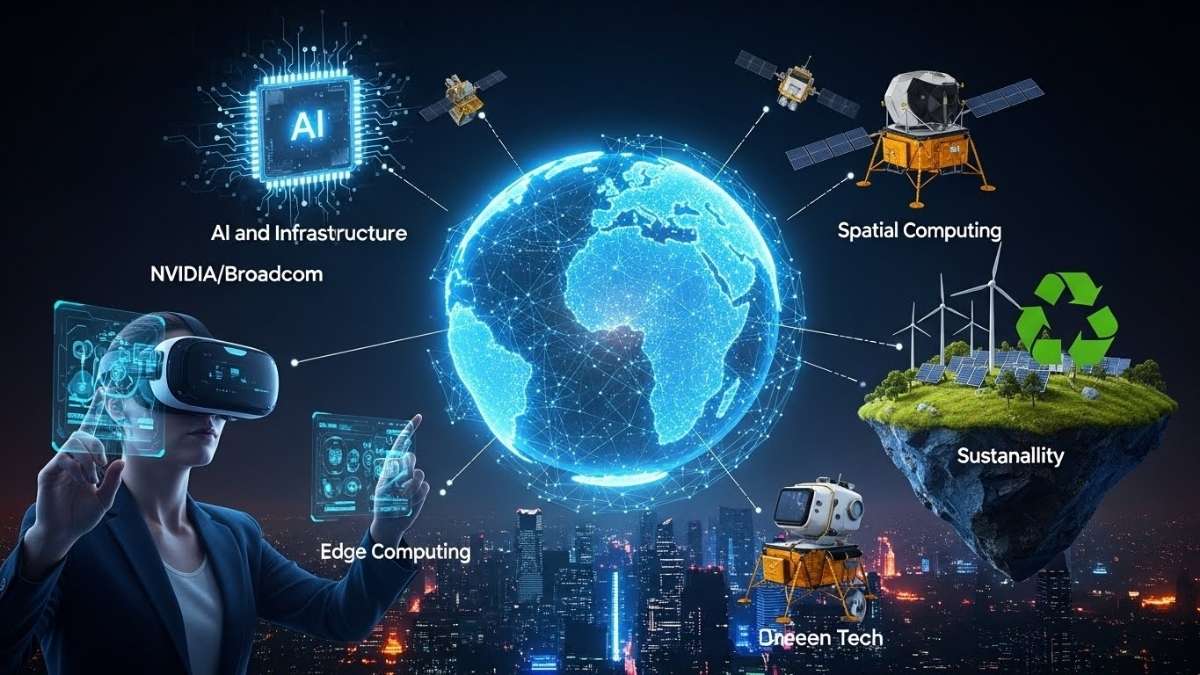
The year 2025 has cemented its place in history as a pivotal moment for technological advancement. We’ve moved beyond mere digital transformation and entered an era of intelligent automation, spatial computing, and deep sustainability integration. The most successful companies this year weren’t just the ones that innovated; they were the ones that scaled their innovations to solve real-world problems—from accelerating drug discovery to enabling truly autonomous business processes.
This comprehensive article dives into the sectors and companies that have defined the technological landscape, becoming the biggest winners of 2025.
The Reign of Artificial Intelligence: From Generative to Agentic
Artificial Intelligence remains the undisputed champion of tech innovation, but the focus has profoundly shifted. 2025 saw AI evolve from being a content-generation tool to becoming a system of autonomous agents capable of making decisions and executing complex tasks without constant human prompting. This shift is the single most powerful driver of productivity and economic value this year.
1. The GPU and AI Infrastructure Architects
The fundamental enablers of the AI revolution are the companies building the raw processing power. The demand for compute resources—especially for training and deploying larger, more capable models—has never been higher.
-
NVIDIA: The Indispensable Giant NVIDIA remains the dominant force. Its full-stack ecosystem, from the CUDA software platform to the latest generation of AI GPUs (like the H200 and newer architectures), ensures its hardware is the default choice for major cloud providers, research labs, and private enterprises. The company’s continued dominance isn’t just about hardware specs; it’s about the deep, sticky integration of their software stack into the AI world. This year, they not only held their market share but solidified their position as the foundational infrastructure of the AI economy.
-
Broadcom: Custom Silicon King While NVIDIA captures the spotlight, Broadcom has emerged as a stealth winner by dominating the market for custom AI silicon. Major tech titans like OpenAI and others are increasingly designing their own chips (ASICs) to optimize for specific AI workloads and reduce dependency on a single vendor. Broadcom’s expertise in design and manufacturing for these complex custom chips has secured multi-billion dollar contracts, leading to exponential revenue growth and establishing it as the critical supplier for the next wave of hyperscale AI.
2. Autonomous and Agentic AI Platforms
Beyond the hardware, the companies that transformed AI from an interesting tool into an indispensable agent have captured massive value.
-
ServiceNow: Digital Workflow Automation Leader ServiceNow has been recognized as one of the world’s most innovative companies, driven by its integration of advanced AI agents into its digital workflow automation platform. Instead of simply automating repetitive tasks (Robotic Process Automation or RPA), ServiceNow’s platform leverages AI agents to handle complex, end-to-end business processes in IT, HR, and Customer Service autonomously. This shift from automation to agentic decision-making significantly boosts enterprise efficiency, making their platform a must-have for Fortune 500 companies.
-
OpenAI/Microsoft: The Generative Ecosystem The partnership between OpenAI and Microsoft continues to redefine productivity. With the widespread deployment of advanced models like GPT-4o, AI-powered assistance has become ubiquitous. Microsoft’s integration of these models into its entire productivity suite—from coding assistance in GitHub Copilot to intelligent agents in Microsoft 365—has driven phenomenal growth in its high-margin cloud services and enterprise software segments. This collaboration has successfully turned groundbreaking research into measurable commercial success.
Redefining Connectivity: The New Space Race and Edge Computing
The next wave of technological growth relies on pushing data processing closer to the user and extending ultra-fast connectivity to every corner of the globe.
1. The Space Economy Accelerates
The space industry is no longer just for government agencies; it’s a rapidly commercializing sector focused on connectivity, Earth observation, and lunar infrastructure.
-
Rocket Lab: The End-to-End Space Solutions Provider While SpaceX remains the private titan, Rocket Lab has excelled in the public market as a key enabler of the small satellite and space systems boom. They are not just a launch provider; they offer a full suite of services, from manufacturing satellite components to building and operating the spacecraft itself (Photon). Their development of the larger Neutron rocket signals a strategic move into higher-end, medium-class launch contracts, directly competing in a growing market for megaconstellation deployments and national security missions.
-
Intuitive Machines: Lunar Commercialization Pioneer Following its historic successful soft-landing on the Moon, Intuitive Machines has capitalized on its first-mover advantage in the commercial lunar sector. As a key NASA partner in the Commercial Lunar Payload Services (CLPS) program, the company is at the forefront of building the infrastructure necessary for a sustained human and robotic presence on the Moon. This is not just a scientific venture, but the foundation of the trillion-dollar cislunar economy.
2. Edge and Spatial Computing
The shift toward Extended Reality (XR) and the need for low-latency processing for AI-powered IoT devices have made Edge Computing a core winning trend.
-
The Rise of Spatial Computing Hardware The increased maturity and accessibility of next-generation AR/VR headsets and glasses has catalyzed the ecosystem. Companies like Apple (with its Vision Pro ecosystem) and other key hardware players are creating a new platform for interaction, driving demand for applications in manufacturing, healthcare, and retail that overlay digital information onto the real world. This is creating a new application layer where developers are starting to see real-world ROI.
-
Cloud Leaders’ Edge Dominance Hyperscalers like Amazon (AWS) and Microsoft (Azure) have seen massive growth in their Edge Computing services. By pushing computing resources to local data centers, factories, and even consumer devices, they reduce latency for time-sensitive AI applications, solidifying their control over the cloud-to-edge continuum.
Sustainable Technology: The Unavoidable Imperative
Sustainability has transitioned from a Corporate Social Responsibility (CSR) initiative to a core business driver, fueled by regulatory pressure and consumer demand. The biggest winners are those integrating Green Tech with fundamental digital tools like AI.
1. Energy Efficiency and Decarbonization Tech
Addressing the massive energy consumption of the digital world—especially the hungry AI data centers—is a major growth area.
-
Innovators in Green Compute Companies that develop energy-efficient computing solutions, including sustainable data center designs and advanced cooling technologies, have seen surging demand. This involves utilizing liquid immersion cooling, optimizing AI model size (smaller, more efficient models), and implementing advanced energy management systems. Microsoft has been highly lauded for its massive investments in renewable energy and its commitment to circular economy practices, such as achieving high reuse rates for server components.
-
Terraformation: Leveraging Tech for Climate Action Terraformation, which won a major Sustainable Technology Award, exemplifies a new breed of climate-first tech company. They utilize technology—specifically their Terraware platform—to scale native forest restoration, combining open-source data with physical technology like solar desalination and advanced seed banking. This approach showcases how digital platforms can drive measurable, positive environmental impact, making them a leader in the crucial Nature-based Solutions sector.
2. Circular Economy and AI-Driven Waste Reduction
The future of manufacturing and resource management is circular, not linear.
-
-
Siemens and Industrial Sustainability Industrial giants like Siemens are winning by integrating digital twins, IoT, and AI into their industrial solutions to enforce resource efficiency and circularity across their supply chains. Their explicit public commitment to drastically cut landfill waste is underpinned by the technology they sell to their customers, making them a leader in providing the tools for the industrial decarbonization movement.
-
Healthcare and Finance: AI’s Transformative Vertical Integration
While AI impacts every industry, its application in healthcare and finance has created unique, high-value market winners due to the sensitivity and complexity of these sectors.
1. Digital Health and Precision Medicine
The convergence of AI, genomics, and advanced diagnostics is turning reactive healthcare into proactive wellness.
-
Illumina and Genomic Data Platforms The ability to rapidly and affordably sequence DNA remains foundational. Illumina continues to pioneer in this space, but the real win is in the platforms that analyze the resulting genomic data. Companies integrating AI for precision medicine—identifying targeted therapies based on a patient’s unique genetic makeup—are driving innovation in oncology and rare disease treatment.
-
Wearable Health and Real-Time Diagnostics Wearable devices have evolved far beyond step-counting. Companies leveraging advanced sensors for real-time health monitoring and AI-driven early disease detection are becoming indispensable for both consumers and health insurance providers, shifting the paradigm towards preventative care.
2. FinTech and AI Governance
In the highly regulated financial sector, the winners are those that balance rapid AI deployment with robust security and compliance.
-
AI Governance Platforms Gartner identified AI Governance Platforms as a top trend, and companies providing these solutions have seen massive uptake. These platforms allow financial institutions (and others) to monitor AI models for bias, ensure regulatory compliance, and mitigate data confidentiality risks. This focus on Responsible AI is a necessary prerequisite for scaling AI in sensitive sectors, creating a lucrative B2B niche.
-
Post-Quantum Cryptography Pioneers Anticipating the threat of quantum computers—which could break today’s standard encryption—companies developing and implementing Post-Quantum Cryptography (PQC) solutions are securing the future of digital transactions. Financial institutions are early adopters, positioning the PQC providers as critical infrastructure defense winners.
Also Read: Adobe Launches Premiere Mobile Hub for YouTube Shorts Creators
Conclusion: The Architecture of Innovation
The biggest winners of 2025 are not defined by a single product, but by their ability to architect interconnected innovation systems. They sit at the convergence points of the major trends:
-
AI Everywhere: Transitioning from simple language models to complex, autonomous agents powered by purpose-built silicon.
-
Global Connectivity: Leveraging the space economy (LEO satellites, lunar infrastructure) to enable ubiquitous, low-latency applications at the network’s Edge.
-
Sustainability as Strategy: Embedding green technology and circularity principles into core business models, driven by both corporate responsibility and economic efficiency.
The companies mentioned—from the foundational hardware players like NVIDIA and Broadcom, to the enterprise transformers like ServiceNow, and the visionary space pioneers like Rocket Lab and Intuitive Machines—have successfully leveraged these technological tides. They are not just participating in the future; they are actively building the intelligent, interconnected, and sustainable world of tomorrow. Their success is a blueprint for every organization looking to thrive in the years to come.